Category Archives: Problems

Visualizing the news with Vivagraph.js

neo_news

Today I want to introduce you to VivaGraphJS – a JavaScript Graph Drawing Library made by Andrei Kashcha of Yasiv. It supports rendering graphs using WebGL, SVG or CSS formats and currently supports a force directed layout. The Library provides an API which tracks graph changes and reflect changes on the rendering surface which makes it fantastic for graph exploration.

Today we will be integrating it with Neo4j and the Alchemy API.

Continue reading

Tagged , , , , , , ,

Knowledge Bases in Neo4j

cnet5promo

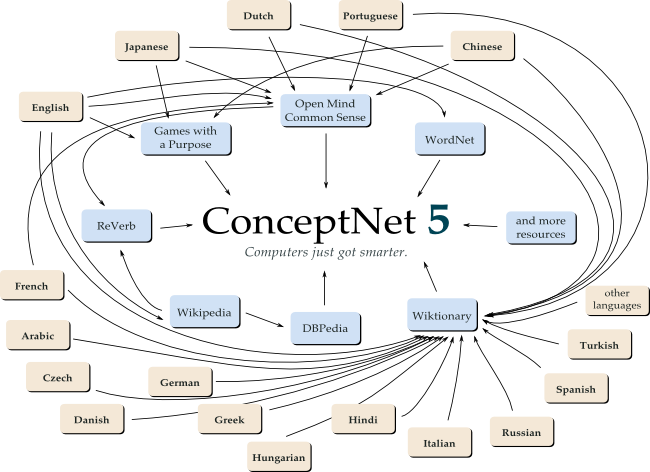
From the second we are born we are collecting a wealth of knowledge about the world. This knowledge is accumulated and interrelated inside our brains and it represents what we know. If we could export this knowledge and give it to a computer, it would look like ConceptNet. ConceptNet is a semantic network that…

…is built from nodes representing concepts, in the form of words or short phrases of natural language, and labeled relationships between them. These are the kinds of things computers need to know to search for information better, answer questions, and understand people’s goals.

Continue reading

Tagged , , , , , , , , ,

Match Making with Neo4j

groucho_marx

It is better to have loft and lost than to never have loft at all.” — Groucho Marx

In the “Matches are the new Hotness” blog post, I showed how to connect a person to a job via a location and skills. We’re going to look at a variation on the theme today by matching people to other people by what they want in a potential mate. We’re gonna use Neo4j to bring the love.
Continue reading

Permission Resolution with Neo4j – Part 3

write_automated_test2

Let’s add a couple of performance tests to the mix. We learned about Gatling in a previous blog post, we’re going to use it here again. The first test will randomly choose users and documents (from the graph we created in part 2) and write the results to a file, the second test will re-use the results of the first one and run consistently so we can change hardware, change Neo4j parameters, tune the JVM, etc. and see how they affect our performance.

The full code for the Random Permissions test is here, I’ll just highlight the main parts:
Continue reading

Tagged , , , , , , ,

Permission Resolution with Neo4j – Part 2

the-princess-bride-original3

Let’s try tackling something a little bigger. In Part 1 we created a small graph to test our permission resolution graph algorithm and it worked like a charm on our dozen or so nodes and edges. I don’t have fast hands, so instead of typing out a million node graph, we’ll build a graph generator and use the batch importer to load it into Neo4j. What I want to create is a set of files to feed to the batch-importer.
Continue reading

Tagged , , , , ,

Permission Resolution with Neo4j – Part 1

i_can_haz_permissions

People produce a lot of content. Messages, text files, spreadsheets, presentations, reports, financials, etc, the list goes on. Usually organizations want to have a repository of all this content centralized somewhere (just in case a laptop breaks, gets lost or stolen for example). This leads to some kind of grouping and permission structure. You don’t want employees seeing each other’s HR records, unless they work for HR, same for Payroll, or unreleased quarterly numbers, etc. As this data grows it no longer becomes easy to simply navigate and a search engine is required to make sense of it all.

But what if your search engine returns 1000 results for a query and the user doing the search is supposed to only have access to see 4 things? How do you handle this? Check the user permissions on each file realtime? Slow. Pre-calculate all document permissions for a user on login? Slow and what if new documents are created or permissions change between logins? Does the system scale at 1M documents, 10M documents, 100M documents?
Continue reading

Tagged , , , , ,

Facebook Graph Search with Cypher and Neo4j

Update: Facebook has disabled this application

Your app is replicating core Facebook functionality.

neo_graph_search_screen_shot

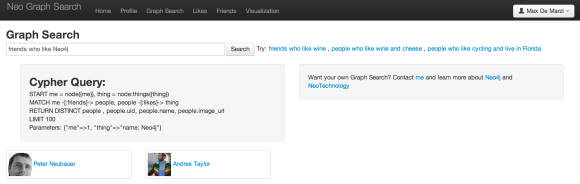
Facebook Graph Search has given the Graph Database community a simpler way to explain what it is we do and why it matters. I wanted to drive the point home by building a proof of concept of how you could do this with Neo4j. However, I don’t have six months or much experience with NLP (natural language processing). What I do have is Cypher. Cypher is Neo4j’s graph language and it makes it easy to express what we are looking for in the graph. I needed a way to take “natural language” and create Cypher from it. This was going to be a problem.
Continue reading

Tagged , , , , , ,

Matches are the New Hotness

How do you help a person without a job find one online? A search screen. How do you help a person find love online? A search screen. How do you find which camera to buy online? A search screen. How do you help a sick person self diagnose online? I have no idea, I go to the doctor. Doesn’t matter, what I want to tell you is that there is another way.
Continue reading

Hunting Trolls with Neo4j!

Allison Sparrow shared a link to Patentula, a company interested in finding better ways to explore patent data and hunt patent trolls. What caught my attention is this quote from the video below:

What we tried to do with it, is bypass any sort of keyword processing in order to find similar patents. The reason we’ve done this is to avoid the problems encountered by other systems that rely on natural language processing or semantic analysis simply because patents are built to avoid detection by similar keywords…we use network topology (specifically citation network topology) to mine the US patent database in order to predict similar documents.

Continue reading

Tagged , , , ,

Networks, Crowds, and Markets


I’ve had “Networks, Crowds, and Markets: Reasoning About a Highly Connected World” by David Easley and Jon Kleinberg on my bookshelf for a few months now, and a conversation with a client reminded me that I hadn’t finished reading it (barely started really). It is available from Cambridge University Press, but also on the web and in PDF format.
Continue reading

Tagged , , , , , , ,