Tag Archives: network

Bidirectional Traversals in Space

firefly

If you have never watched Firefly, then stop whatever you are doing and get to it, you can come back and read this post later. Ok good, now where were we. Firefly. The series is set a few hundred years from now, after people begin to terraform a new star system and it follows the adventures of the renegade crew of Serenity, a “Firefly-class” spaceship whose work consists of cargo runs or smuggling while failing to stay out of trouble. There is no faster than light travel in this series, so ships can’t just “warp” where ever they want. Instead they travel about from planets and moons, exchanging cargo, refueling and trying to make a living. We are going to model “The Verse” of Firefly in Neo4j, and see how we can find routes to move our illicit cargo from one place to another.
Continue reading

Tagged , , , , , , , , ,

Flight Search with the Neo4j Traversal API

Screen Shot 2015-08-30 at 2.21.07 AM

Before Cypher came along, if you wanted to describe a graph traversal in Neo4j you would use the Traversal Framework Java API. The Traversal API is one of the many hidden gems of Neo4j and today we are going to take a closer look at it. Traversing a graph is about going on a journey. All journeys have a starting point (or points) so that’s the first thing we have to do, figure out where in the graph we begin. It can be a single node, or multiple ones, but they will go on the journey following the same rules, so its easier if it’s just one node or nodes of the same “type”.
Continue reading

Tagged , , , , , , , , ,

Importing the Hacker News Interest Graph

HackerNews-799e9e47

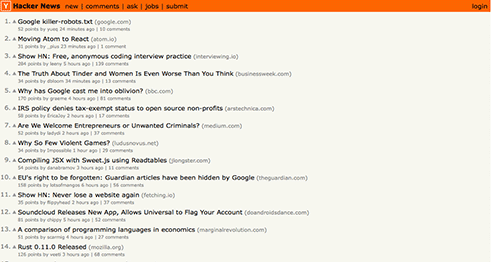
Graphs are everywhere. Think about the computer networks that allow you to read this sentence, the road or train networks that get you to work, the social network that surrounds you and the interest graph that holds your attention. Everywhere you look, graphs. If you manage to look somewhere and you don’t see a graph, then you may be looking at an opportunity to build one. Today we are going to do just that. We are going to make use of the new Neo4j Import tool to build a graph of the things that interest Hacker News.
Continue reading

Tagged , , , , , , , , , , , ,

Triggers in Neo4j

al-capones-gun

One of the often overlooked features in Neo4j is the “TransactionEventHandler” capabilities… better known in the database world as “Triggers“. When a transaction occurs, we can analyze that event and decide to take some action. To accomplish this, we’ll write a “Kernel Extension” ( a little different from the Unmanaged Extensions we’ve seen on this blog ) to tie in our trigger.

Continue reading

Tagged , , , , , ,

Giving Neo4j 2.2 a Workout

rhino_running

Neo4j 2.2 is getting released any day now, so let’s put the Release Candidate through its paces with Gatling. Once we download and start it up, you’ll notice it wants us to authenticate.
Continue reading

Tagged , , , , , , , ,

Tracking User Paths in an IVR with Neo4j

I started my software development career writing applications for a Call Center at a small bank in Florida. I remember the bank had purchased whatever the “Cadillac” of Interactive Voice Response (IVR) systems was then for some crazy amount of money. Today you can build an IVR overnight using Twilio.

twilio

When you sign up with Twilio, you get to choose your phone number (more or less). For example, I picked +1 (636) 451-7411, which spells out +1 (neo) 4j1-7411. If you were to call this number right now (assuming I have not run out of Twilio credits) you’ll connect to my IVR.
Continue reading

Tagged , , , , ,

Online Payment Risk Management with Neo4j

credit_cards_512

I really like this saying by Corey Lanum:

Finding the relationships that should not be there is a great use case for Neo4j, and today I want to highlight an example of why. When you purchase something online, the merchant hands off your information to the payment gateway which processes your actual payment. Before they accept the transaction, they run it via series of risk management tests to validate that it is a real transaction and protect themselves from fraud. One of the hardest things for SQL based systems to do is cross check the incoming payment information against existing data looking for relationships that shouldn’t be there.
Continue reading

Tagged , , , , , , , ,

Neo4j Spatial Part 2

nomnomnom

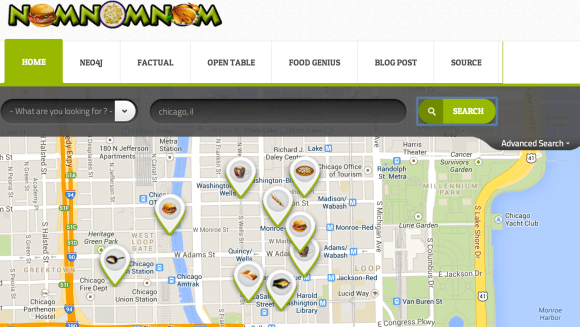
In part 1 of this series we looked at how to get started with Neo4j Spatial and we looked at some of the pieces we’ll use today to build a proof of concept application. I’m calling the application “Nom Nom Nom” in reference to its onomatopoeic meme.

So we’ll get data from Factual, get data from OpenTable, combine them and import them into Neo4j:

Continue reading

Tagged , , , ,

Neo4j Spatial Part 1

http://www.iconarchive.com/show/gis-gps-map-icons-by-icons-land/Layers-icon.html

One of my new year resolutions is to do a project with Neo4j Spatial, so we’ll kick off my first blog post of the year with a gentle introduction to this awesome plugin. I advise you to watch this very short 15 minute video by Neo4j Spatial creator Craig Taverner. The man is a genius level developer, you’ll gain IQ points just listening, I swear.

The plan is to make a Restaurant Recommendation engine based on things you care about and your current location. Yes, this is baby level stuff, but we’ll start with this and see where else Neo4j Spatial can take us later on.
Continue reading

Tagged , , , , , , ,

The Power of Open Source Software

opensource-400

One of the benefits of Open Source Software is that if you want to change how something is done, you can. At Neo Technology, we have a small team of “Field Engineers” who don’t really work ON the product but rather WITH the product. We help our customers with issues of all kinds, answer questions, give suggestions and whatever we need to do to make people’s project successful. A little while back I had a support ticket for a traversal that was taking longer than they hoped it would.

Think about a social network, one of the things you may want to do is tell the user how big their friends network is. But why stop there? How about their friends of friends or even friends of friends of friends network? These are the kind of questions graph databases excel at compared to relational databases. Let’s take a look at what they were doing:
Continue reading

Tagged , , , , , ,