Max Flow with Gremlin and Transactions

The maximum flow problem was formulated by T.E. Harris as follows:

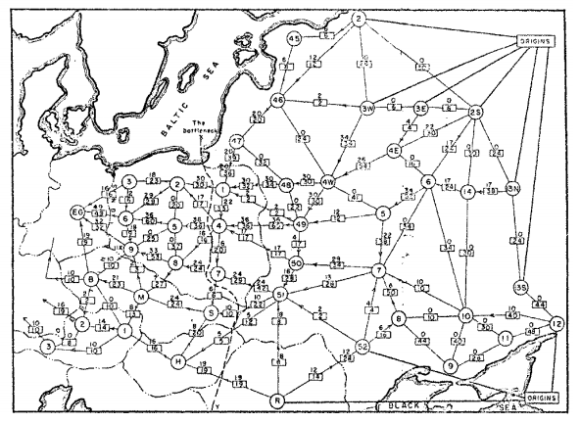
Consider a rail network connecting two cities by way of a number of intermediate cities, where each link of the network has a number assigned to it representing its capacity. Assuming a steady state condition, a nd a maximal flow from one given city to the other.

Back in the mid 1950s the US Military had an interest in finding out how much capacity the Soviet railway network had to move cargo from the Western Soviet Union to Eastern Europe. This lead to the Maximum Flow problem and the Ford–Fulkerson algorithm to solve it.
Continue reading

Tagged , , , , ,

Importing Wikipedia into Neo4j with Graphipedia

Wouldn’t it be cool to import Wikipedia into Neo4j?

Mirko Nasato thought so, and built graphipedia using the batch importer that does just that.

It’s written in Java, so if you’re a pure ruby guy, I’ll walk you through the steps.

Let’s clone the project and jump in.

git clone git://github.com/mirkonasato/graphipedia.git
cd graphipedia

If you look in here you’ll see a pom.xml file which means you’ll need to download Maven and build the project.

sudo apt-get install maven2
mvn install

You’ll see a bunch of stuff flying by, that’s just the dependencies being downloaded. At the end you should see this:
Continue reading

Tagged , , ,

Visualizing a Network with Cypher and D3.js

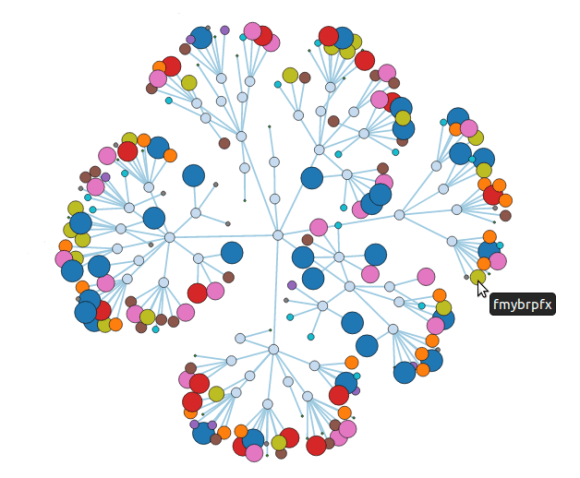
We’ve seen some pretty nice visualizations of nodes and their immediate neighbors, but we want to be able to visualize more. So we’re going to prepare a 200 node network, use Cypher to extract the data we want and visualize it with D3.js.
Continue reading

Tagged , , , , , , ,

Graph Visualization and Neo4j – Part Three

Like I promised in my previous post, I wanted to do a little something on D3.js.

We are going to take one of their example visualizations and visualize a follows graph.

To create our graph, we will take the names of 20 people: create nodes for them, add them to an index, and randomly link them together.
Continue reading

Tagged , , , , ,

Graph Visualization and Neo4j – Part Two

If you’re into NoSQL and Graph Databases like Neo4j, then you’ll probably tend to be working on back-end development. If you’re lucky enough to work in a team of specialists, some UX guy will come up with user requirements, hand them off to a UI gal for design, who will then pass it on to a Javascript Ninja to slice it together and they’ll just ask you provide the data and stuff it in a JSON object.

If you’re not so lucky and are working on pet projects by yourself then you’ll have to do it all. So I wanted to give you a little nudge into learning a visualization framework. Since my most popular blog post so far has been Graph Visualization and Neo4j and we’ve already seen one example that you’ll probably want to customize in your projects, we’ll stick with processing.js, and in the future I can do a little intro on D3.js, Unveil.js and maybe something a little crazier like VVVV.js.

So getting started is really easy. We’ll create an html document, add the minified processing javascript library and create a canvas element to put our visualization.

<!DOCTYPE html>
<html>
	<head>
		<title>Hello World - Processing.js</title>
		<script src="processing-1.3.6.min.js"></script>
	</head>
	<body>
		<canvas data-src="helloworld.pjs"></canvas>
	</body>
</html>

All right, let’s create the helloworld.pjs we reference as our canvas data source.
Continue reading

Tagged , , , ,

Who is the Greatest?

I done wrestled with an alligator, I done tussled with a whale, only last week I murdered a rock, injured a stone, hospitalized a brick. I’m so mean I make medicine sick.

He floats like a butterfly and stings like a bee, but is Muhammad Ali truly the greatest? Greater than the Beatles? Greater than Alexander? Greater than Sliced Bread? Let’s find out.

We begin by requiring neography and creating a function to help us create the greats.

require 'rubygems'
require 'neography'

def create_great(name)
  Neography::Node.create("name" => name)
end

There are a ton of greats out there, but we’ll keep it simple and create just 8 of the greatest greats.
Continue reading

Tagged , , , , ,

Chicago Graph DB Meet-Up

We had our first Graph Database Meet-up in Chicago yesterday!

16 Graphistas came out to learn more about the craft and get an introduction to Neo4j. Ryan Briones from Groupon gave us a venue and helped host the event. No worries if you missed it, your next chance to learn more about Neo4j is coming up on Tuesday February 7th @ 6pm, when Prasanna Pendse will share his experiences with Neo4j at ChicagoRuby: Downtown.

Our next Chicago Graph DB meet-up is tentatively scheduled for February 29th @ 6 pm. This will be a hands-on meet-up. I’ll help you get started with either Neo4j on your laptop or in the cloud with Heroku. We’ll create a few graphs, learn some basic traversals and get comfortable with Neo4j. I’ll have a GitHub repository graph for us to play with and see how you are connected to Kevin Bacon (err I mean Linus Torvalds). He is the center of the GitHub universe right? Right? We’ll let’s find out.

The slides of our first meet-up are available below:

Tagged , , , , ,

Neo4j on Heroku – Part Three

This week we learned that leaving the create_graph method accessible to the world was a bad idea. So let’s go ahead and delete that route in Sinatra, and instead create a Rake Task for it.

In Rakefile:

require 'neography/tasks'
require './neoflix.rb'

namespace :neo4j do
  task :create do
    neo = Neography::Rest.new(ENV['NEO4J_URL'] || "http://localhost:7474")
    create_graph(neo)
  end
end

That’s much better. We can create our graph locally with
Continue reading

Tagged , , , ,

Neo4j on Heroku – Part Two

We are picking up where we left off on Neo4j on Heroku –Part One so make sure you’ve read it or you’ll be a little lost. So far, we have cloned the Neoflix project, set up our Heroku application and added the Neo4j add-on to our application. We are now ready to populate our graph.

UPDATE: Learn a better way to create the graph in part 3 of my Neo4j on Heroku series.

Bring up two browser windows. On one you’ll go to your Neo4j instance running on Heroku,

$ heroku config
NEO4J_URL      => http://xxxxxxxx:yyyyyyyy@70825a524.hosted.neo4j.org:7014

and on the other you’ll go to the create_graph route of your app. So if you named your app neoflix, you’d go to neoflix dot herokuapp dot com/create_graph.

This will run the create_graph method and you’ll see nodes and relationships being created on the Neo4j Dashboard. It’s just over a million relationships, so it will take a few minutes. There are faster ways to load data into Neo4j (wait for part three of this series), but this will work in our case.
Continue reading

Tagged ,

Neo4j on Heroku – Part One

On his blog Marko A. Rodriguez showed us how to make A Graph-Based Movie Recommender Engine with Gremlin and Neo4j.

In this two part series, we are going to take his work from the Gremlin shell and put it on the web using the Heroku Neo4j add-on and altering the Neovigator project for our use case. Heroku has a great article on how to get an example Neo4j application up and running on their Dev Center and Michael Hunger shows you how to add JRuby extensions and provides sample code using the Neo4j.rb Gem by Andreas Ronge.

We are going to follow their recipe, but we are going to add a little spice. Instead of creating a small 2 node, 1 relationship graph, I am going to show you how to leverage the power of Gremlin and Groovy to build a much larger graph from a set of files.

Let’s start by cloning the Neoflix Sinatra application, and instead of installing and starting Neo4j locally, we are going to create a Heroku application, and add Neo4j.

git clone git@github.com:maxdemarzi/neoflix.git
cd neoflix
bundle install
heroku apps:create neoflix --stack cedar
heroku addons:add neo4j
git push heroku master

Continue reading

Tagged