Category Archives: Problems

Caching Partial Traversals in Neo4j

cache_all_the_things

Sometimes you’ll find yourself looking at a traversal and thinking… “I’m going to be doing this one thing over and over again.” That sounds kind of wasteful and years of recycling have taught us not to be wasteful. Let’s take a look at an example from our past. Look back at the Neo Love application, the one with the picture of Marilyn Monroe and Groucho Marx. Let’s see what a Neo4j 2.0 version of that query would look like:

Continue reading

Tagged , , , , , , , ,

It’s over 9000! Neo4j on WebSockets

it__s_over_9000_

In the last blog post we managed to run Neo4j at Ludicrous Speed over http using Undertow and get to about 8000 requests per second. If we needed more speed we can scale up the server or we can scale out to multiple servers by switching out the GraphDatabaseFactory and using the HighlyAvailableGraphDatabaseFactory class instead in Neo4j Enterprise Edition.

But can we go faster on a single server without new hardware? Well… yes, if we’re willing to drop http and switch to Web Sockets.

Continue reading

Tagged , , , , , , , ,

Neo4j at Ludicrous Speed

spaceballs_ludicrous_speed

In the last blog post we saw how we could get about 1,250 requests per second (with a 10ms latency) using an Unmanaged Extension running inside the Neo4j server… but what if we wanted to go faster?

The easy answer is to Scale Up. However, trying to add more cores to my Apple laptop doesn’t sound like a good time. Another answer is running a Neo4j Cluster and (almost) linearly scaling our read requests as we add more servers. So a 3 server cluster would give us between 3,500 and 3,750 requests per second.

But can we go faster on a single server without new hardware? Well… yes.
Continue reading

Tagged , , , ,

Online Payment Risk Management with Neo4j

credit_cards_512

I really like this saying by Corey Lanum:

Finding the relationships that should not be there is a great use case for Neo4j, and today I want to highlight an example of why. When you purchase something online, the merchant hands off your information to the payment gateway which processes your actual payment. Before they accept the transaction, they run it via series of risk management tests to validate that it is a real transaction and protect themselves from fraud. One of the hardest things for SQL based systems to do is cross check the incoming payment information against existing data looking for relationships that shouldn’t be there.
Continue reading

Tagged , , , , , , , ,

Neo4j Spatial Part 2

nomnomnom

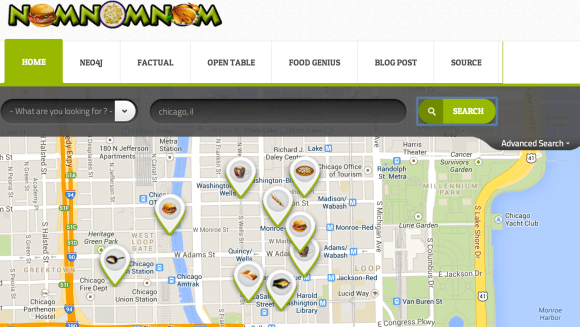
In part 1 of this series we looked at how to get started with Neo4j Spatial and we looked at some of the pieces we’ll use today to build a proof of concept application. I’m calling the application “Nom Nom Nom” in reference to its onomatopoeic meme.

So we’ll get data from Factual, get data from OpenTable, combine them and import them into Neo4j:

Continue reading

Tagged , , , ,

The Power of Open Source Software

opensource-400

One of the benefits of Open Source Software is that if you want to change how something is done, you can. At Neo Technology, we have a small team of “Field Engineers” who don’t really work ON the product but rather WITH the product. We help our customers with issues of all kinds, answer questions, give suggestions and whatever we need to do to make people’s project successful. A little while back I had a support ticket for a traversal that was taking longer than they hoped it would.

Think about a social network, one of the things you may want to do is tell the user how big their friends network is. But why stop there? How about their friends of friends or even friends of friends of friends network? These are the kind of questions graph databases excel at compared to relational databases. Let’s take a look at what they were doing:
Continue reading

Tagged , , , , , ,

Scaling Up

scaling-up

Rock climbing is a physically and mentally demanding sport, it test the limits of one’s strength, endurance, agility, balance and concentration. Sasha DiGiulian is one of the best rock climbers in the world. I can’t get past 15 feet without starting to panic and freak out. Maybe it’s because I’m afraid of heights…and overweight, but I’m just not right for that kind of challenge.
Continue reading

Tagged , , , , ,

Scaling Writes

scaling_writes

Most of the applications using Neo4j are read heavy and scale by getting more powerful servers or adding additional instances to the HA cluster. Writes however can be a little bit tricker. Before embarking on any of the following strategies it is best that the server is tuned. See the Linux Performance Guide for details. One strategy we’ve seen already is splitting the reads and writes to the cluster, so the writes only go to the Master. The brave can even change the push factor to zero and set a pull interval only in neo4j/conf/neo4j.properties:
Continue reading

Tagged , , , , ,

Connected

connected

Connected: The Surprising Power of Our Social Networks and How They Shape Our Lives is a mind bending look at how no matter how individual we think we are, the people around us have a great amount of influence in our lives. One of the authors James Fowler was at GraphConnect 2012 and gave a presentation on this idea:

Continue reading

Tagged , , , , , , ,

The Last Mile

Last-Mile

The “last mile” is a term used in the telecommunications industry that refers to delivering connectivity to the customers that will actually be using the system. In the sense of Graph Databases, it refers to how well the end user can extract value and insight from the graph. We’ve already seen an example of this concept with Graph Search, allowing a user to express their requests in natural language. Today we’ll see another example. We’ll be taking advantage of the features of Neo4j 2.0 to make this work, so be sure to have read the previous post on the matter.

We’re going to be using VisualSearch.js made by Samuel Clay of NewsBlur. VisualSearch.js enhances ordinary search boxes with the ability to autocomplete faceted search queries. It is quite easy to customize and there is an annotated walkthrough of the options available. You can see what it does in the image below, or click it to try their demo.

Continue reading

Tagged , , , , , , ,