Tag Archives: graph

Scaling Up

scaling-up

Rock climbing is a physically and mentally demanding sport, it test the limits of one’s strength, endurance, agility, balance and concentration. Sasha DiGiulian is one of the best rock climbers in the world. I can’t get past 15 feet without starting to panic and freak out. Maybe it’s because I’m afraid of heights…and overweight, but I’m just not right for that kind of challenge.
Continue reading

Tagged , , , , ,

Connected

connected

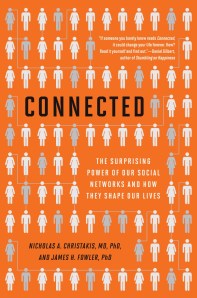
Connected: The Surprising Power of Our Social Networks and How They Shape Our Lives is a mind bending look at how no matter how individual we think we are, the people around us have a great amount of influence in our lives. One of the authors James Fowler was at GraphConnect 2012 and gave a presentation on this idea:
Continue reading

Tagged , , , , , , ,

Neo4j 2.0 is coming

neoiscoming

House Neo4j of Graph Databases is one of the Great Houses of NOSQL and the principal noble house of The Graph; many lesser houses are sworn to them. In days of old they ruled as Kings of the Graph; since the Aggregate Store Conquest they have been Wardens of the Path. Their seat, San Mateo, is an ancient castle renowned for its sushi. Their sigil is a octopus racing across a field of white, and their words are “Neo4j 2.0 Is Coming,” one of only a few house mottoes to be a warning rather than a boast. Members of the family tend to be lean of build and long of face, with golden hair and blue eyes.

Continue reading

Tagged , , , , , ,

Permission Resolution with Neo4j – Part 3

write_automated_test2

Let’s add a couple of performance tests to the mix. We learned about Gatling in a previous blog post, we’re going to use it here again. The first test will randomly choose users and documents (from the graph we created in part 2) and write the results to a file, the second test will re-use the results of the first one and run consistently so we can change hardware, change Neo4j parameters, tune the JVM, etc. and see how they affect our performance.

The full code for the Random Permissions test is here, I’ll just highlight the main parts:
Continue reading

Tagged , , , , , , ,

Permission Resolution with Neo4j – Part 2

the-princess-bride-original3

Let’s try tackling something a little bigger. In Part 1 we created a small graph to test our permission resolution graph algorithm and it worked like a charm on our dozen or so nodes and edges. I don’t have fast hands, so instead of typing out a million node graph, we’ll build a graph generator and use the batch importer to load it into Neo4j. What I want to create is a set of files to feed to the batch-importer.
Continue reading

Tagged , , , , ,

Networks, Crowds, and Markets


I’ve had “Networks, Crowds, and Markets: Reasoning About a Highly Connected World” by David Easley and Jon Kleinberg on my bookshelf for a few months now, and a conversation with a client reminded me that I hadn’t finished reading it (barely started really). It is available from Cambridge University Press, but also on the web and in PDF format.
Continue reading

Tagged , , , , , , ,

Summarize Opinions with a Graph – Part 1

How does the saying go? Opinions are like bellybuttons, everybody’s got one? So let’s say you have an opinion that NOSQL is not for you. Maybe you read my blog and think this Graph Database stuff is great for recommendation engines and path finding and maybe some other stuff, but you got really hard problems and it can’t help you.

I am going to try to show you that a graph database can help you solve your really hard problems if you can frame your problem in terms of a graph. Did I say “you”? I meant anybody, specially Ph.D. students. One trick is to search for “graph based approach to” and your problem.
Continue reading

Tagged , ,

Key Players

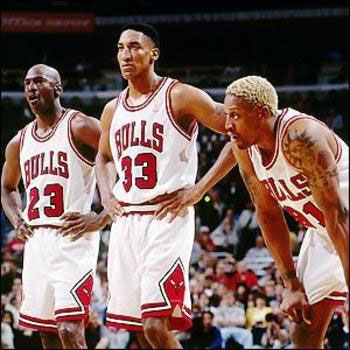
In the late 90s Michael Jordan, Scottie Pippen, and Dennis Rodman of the Chicago Bulls dominated the basketball court. They were the key players of the Chicago Bulls, and dominated the NBA offensively and defensively. When exploring a social network you’ll want to find who the key players are for a variety of reasons:

Disrupt: Who should be removed from the network to disrupt it?
Protect: Who should be protected in order to keep the network functioning?
Influence: Who should be influenced in order to change social opinion?
Learn: Who should be questioned in order to know what is going on?
Redirect: Who should be moved to alter social flows?
Continue reading

Tagged , ,

Graph Visualization and Neo4j – Part Two

If you’re into NoSQL and Graph Databases like Neo4j, then you’ll probably tend to be working on back-end development. If you’re lucky enough to work in a team of specialists, some UX guy will come up with user requirements, hand them off to a UI gal for design, who will then pass it on to a Javascript Ninja to slice it together and they’ll just ask you provide the data and stuff it in a JSON object.

If you’re not so lucky and are working on pet projects by yourself then you’ll have to do it all. So I wanted to give you a little nudge into learning a visualization framework. Since my most popular blog post so far has been Graph Visualization and Neo4j and we’ve already seen one example that you’ll probably want to customize in your projects, we’ll stick with processing.js, and in the future I can do a little intro on D3.js, Unveil.js and maybe something a little crazier like VVVV.js.

So getting started is really easy. We’ll create an html document, add the minified processing javascript library and create a canvas element to put our visualization.

<!DOCTYPE html>
<html>
	<head>
		<title>Hello World - Processing.js</title>
		<script src="processing-1.3.6.min.js"></script>
	</head>
	<body>
		<canvas data-src="helloworld.pjs"></canvas>
	</body>
</html>

All right, let’s create the helloworld.pjs we reference as our canvas data source.
Continue reading

Tagged , , , ,

Graph Visualization and Neo4j

So far we’ve learned how to get Neo4j up and running with Neography, how to find friends of friends and degrees of separation with the Neo4j REST API and a little bit of the Gremlin and Cypher languages. However, all we’ve seen is text output. We haven’t really “seen” a graph yet, but that’s about to change.

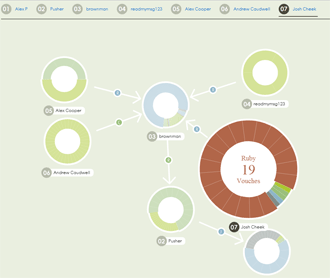
Vouched holds a graph of skill specific recommendations people have made to each other and visualizes it. I extracted the visualization, and hosted it on github as neovigator. You can get your very own visualization up and running or take a look at this instance running on Heroku.

Continue reading

Tagged , , , , , ,