Neo4j on Heroku – Part One

On his blog Marko A. Rodriguez showed us how to make A Graph-Based Movie Recommender Engine with Gremlin and Neo4j.

In this two part series, we are going to take his work from the Gremlin shell and put it on the web using the Heroku Neo4j add-on and altering the Neovigator project for our use case. Heroku has a great article on how to get an example Neo4j application up and running on their Dev Center and Michael Hunger shows you how to add JRuby extensions and provides sample code using the Neo4j.rb Gem by Andreas Ronge.

We are going to follow their recipe, but we are going to add a little spice. Instead of creating a small 2 node, 1 relationship graph, I am going to show you how to leverage the power of Gremlin and Groovy to build a much larger graph from a set of files.

Let’s start by cloning the Neoflix Sinatra application, and instead of installing and starting Neo4j locally, we are going to create a Heroku application, and add Neo4j.

git clone git@github.com:maxdemarzi/neoflix.git
cd neoflix
bundle install
heroku apps:create neoflix --stack cedar
heroku addons:add neo4j
git push heroku master

Continue reading

Tagged

Graph Visualization and Neo4j

So far we’ve learned how to get Neo4j up and running with Neography, how to find friends of friends and degrees of separation with the Neo4j REST API and a little bit of the Gremlin and Cypher languages. However, all we’ve seen is text output. We haven’t really “seen” a graph yet, but that’s about to change.

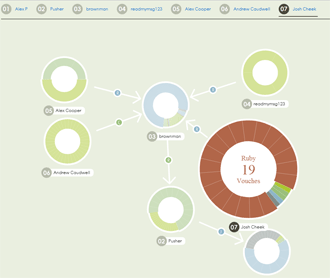
Vouched holds a graph of skill specific recommendations people have made to each other and visualizes it. I extracted the visualization, and hosted it on github as neovigator. You can get your very own visualization up and running or take a look at this instance running on Heroku.

Continue reading

Tagged , , , , , ,

Cypher with Neography

Cypher is the query language of Neo4j, and as promised I’ll show you how you can use it to implement friend recommendations as well as degrees of separation.

We can send any cypher query to Neo4j via the REST API and neography using the execute_query command. Let’s implement suggestions_for so it sends a cypher query to the server:

def suggestions_for(node)
  node_id = node["self"].split('/').last.to_i
  @neo.execute_query("START me = node({node_id})
                      MATCH (me)-[:friends]->(friend)-[:friends]->(foaf)
                      RETURN foaf.name", {:node_id => node_id})["data"]
end

puts "Johnathan should become friends with #{suggestions_for(johnathan).join(', ')}"

# RESULT
# Johnathan should become friends with Mary, Phil

Continue reading

Tagged , , ,

Gremlin with Neography

Gremlin is a domain specific language for traversing property graphs. Neo4j is one of the databases that can speak the gremlin language, and as promised I’ll show you how you can use it to implement friend recommendations as well as degrees of separation.

We can send any gremlin script to Neo4j via the REST API and neography using the execute_script command. Let’s implement suggestions_for so it sends a gremlin script to the server:

def suggestions_for(node)
  node_id = node["self"].split('/').last.to_i
  @neo.execute_script("g.v(node_id).
                         in('friends').
                         in('friends').
                         dedup.
                         filter{it != g.v(node_id)}.
                         name", {:node_id => node_id})
end

puts "Johnathan should become friends with #{suggestions_for(johnathan).join(', ')}"

# RESULT
# Johnathan should become friends with Mary, Phil

Continue reading

Tagged , , , ,

How you’re connected to Kevin Bacon

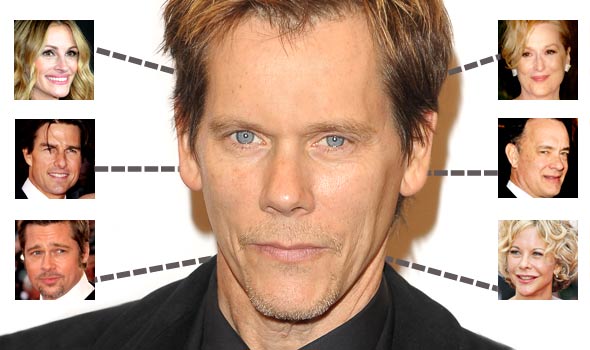
Previously I showed you how to get Neo4j up and running with Ruby and how to find recommended friends on a social network. What about finding out how you are connected to someone outside of your friends of friends network? Do you remember the concept of six degrees of separation? No, how about six degrees of Kevin Bacon?

A credit card commercial explains how this works:

The actor, Kevin Bacon wants to write a check to buy a book, but the clerk asks for his ID, which he does not have. He leaves and returns with a group of people, then says to the clerk, “Okay, I was in a movie with an extra, Eunice, whose hairdresser, Wayne, attended Sunday school with Father O’Neill, who plays racquetball with Dr. Sanjay, who recently removed the appendix of Kim, who dumped you sophomore year. So you see, we’re practically brothers.”

Continue reading

Tagged , , ,

Getting started with Ruby and Neo4j

Getting started with Ruby and Neo4j is very easy.
Follow these steps and you’ll be up and running in no time.

First we install the neography gem:

Using Bundler:

echo "source 'http://rubygems.org'
gem 'neography' " > Gemfile
bundle install 

Without Bundler:

gem install neography

Then we’ll add our tasks to a Rakefile, download Neo4j and start it:

echo "require 'neography/tasks'" > Rakefile
rake neo4j:install
rake neo4j:start

Continue reading

Tagged , ,