Category Archives: Cypher

Neo4j and Gatling sitting in a tree, Performance T-E-S-T-ing

neo4j_loves_gatling

I was introduced to the open-source performance testing tool Gatling a few months ago by Dustin Barnes and fell in love with it. It has an easy to use DSL, and even though I don’t know a lick of Scala, I was able to figure out how to use it. It creates pretty awesome graphics and takes care of a lot of work for you behind the scenes. They have great documentation and a pretty active google group where newbies and questions are welcomed.

It ships with Scala, so all you need to do is create your tests and use a command line to execute it. I’ll show you how to do a few basic things, like test that you have everything working, then we’ll create nodes and relationships, and then query those nodes.
Continue reading

Tagged , , , , , , ,

Facebook Graph Search with Cypher and Neo4j

Update: Facebook has disabled this application

Your app is replicating core Facebook functionality.

neo_graph_search_screen_shot

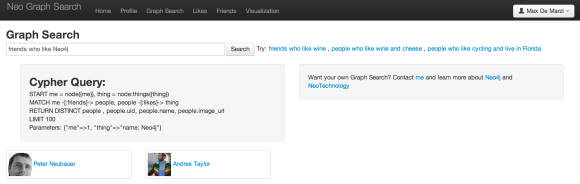
Facebook Graph Search has given the Graph Database community a simpler way to explain what it is we do and why it matters. I wanted to drive the point home by building a proof of concept of how you could do this with Neo4j. However, I don’t have six months or much experience with NLP (natural language processing). What I do have is Cypher. Cypher is Neo4j’s graph language and it makes it easy to express what we are looking for in the graph. I needed a way to take “natural language” and create Cypher from it. This was going to be a problem.
Continue reading

Tagged , , , , , ,

Extending Neo4j

One of the great things about Neo4j is how easy it is to extend it. You can extend Neo4j with Plugins and Unmanaged Extensions. Two great examples of plugins are the Gremlin Plugin (which lets you use the Gremlin library with Neo4j) and the Spatial Plugin (which lets you perform spatial operations like searching for data within specified regions or within a specified distance of a point of interest).

Plugins are meant to extend the capabilities of the database, nodes, or relationships. Unmanaged extensions are meant to let you do anything you want. This great power comes with great responsibility, so be careful what you do here. David Montag cooked up an unmanaged extension template for us to use on github so lets give it a whirl. We are going to clone the project, compile it, download Neo4j, configure Neo4j to use the extension, test the extension and tweak it a bit.
Continue reading

Tagged , , , , , , , , , ,

CrunchBase on Neo4j

NeoTechnology was featured on TechCrunch after raising a Series B round, and it has an entry on CrunchBase. If you look at CrunchBase closely you’ll notice it’s a graph. Who invested in what, who co-invested, what are the common investment themes between investors, how are companies connected by board members, etc. These are questions we can ask of the graph and are well suited for graph databases.
Continue reading

Tagged , , , , , , ,

Matches are the New Hotness

How do you help a person without a job find one online? A search screen. How do you help a person find love online? A search screen. How do you find which camera to buy online? A search screen. How do you help a sick person self diagnose online? I have no idea, I go to the doctor. Doesn’t matter, what I want to tell you is that there is another way.
Continue reading

Hubway Data Visualization Challenge with Neo4j

Michael Hunger imported the Hubway Challenge dataset into a Neo4j graph database, and made it available for us to play with.
Continue reading

Tagged , , , , , , ,

NeoSocial: Connecting to Facebook with Neo4j

Social applications and Graph Databases go together like peanut butter and jelly. I’m going to walk you through the steps of building an application that connects to Facebook, pulls your friends and likes data and visualizes it. I plan on making a video of me coding it one line at a time, but for now let’s just focus on the main elements.
Continue reading

Tagged , , , , , , , ,

HCIR 2012

A tweet from RiparianData caught my eye the other day:

https://twitter.com/RiparianData/status/222319315800698880

I built getvouched.com with this idea of “expert and expertise discovery” using skill based vouching adjusted by the distance from searcher to target as a way to find rank. So I dug in and found out that Human-computer Information Retrieval (HCIR) combines research from the fields of human-computer interaction (HCI) and information retrieval (IR), placing an emphasis on human involvement in search activities.

The HCIR challenge for this years symposium includes “hiring,” “assembling a conference program,” and “finding people to deliver patent research or expert testimony” as summarized by Patrick Durusau.
Continue reading

Tagged , , , , ,

Personalization with Cypher

You hopefully have seen a TV commercial from “The Man Your Man Could Smell Like” marketing campaign put on by Old Spice, and you may have seen some of the over 100 videos Isaiah Mustafa appeared in responding to comments made on Twitter. This is a great example of personalization, and today you’ll learn how you can bring some personalization to your application, and you won’t need muscles or a horse.

We’re going to dust off the Neoflix project from the beginning of the year and add a few features. It has been updated to work on Neo4j version 1.7 and allows searching for movies that have a quote. Thanks to Jenn Alons and Vince Cima for the bug fixes during WindyCityDB.
Continue reading

Tagged , , ,

Using Three.js with Neo4j

Last week we saw Sigma.js, and as promised here is a graph visualization with Three.js and Neo4j. Three.js is a lightweight 3D library, written by Mr. Doob and a small army of contributors.

The things you can do with Three.js are amazing, and my little demo here doesn’t give it justice, but nonetheless I’ll show you how to build it.
Continue reading

Tagged , , , , , ,