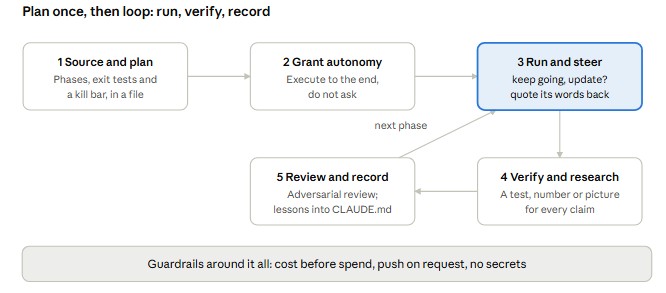
I’ve been using Claude for about 6 months and have fallen into a pattern that seems to work for me. If you are new to Agentic development this may help you. If you’ve been at it for a while, maybe you want to compare how we differ and hopefully take something away (or even better, send me a tip). I asked Claude to take a look at the logs from my personal account (not my work account) and tell me how I used it, turns out it’s basically the same. The image above and the content below is what it came up with. One of the things we’ve done since day one at Relational AI is take the latest and greatest database research and add it to the product. We have a whole bunch of researchers on staff and collaborate with many others in academia. Normally it would take a long time to go from published paper to production code, but that time is becoming shorter and shorter.
I start off by getting a PDF of a recently published paper of interest. If it has code it’s better, but as long as the idea is captured in the paper, Claude can figure it out. I start out by asking Claude to read the paper, then I use the first set of magic words:
Create an extensive multi phase plan to implement that paper as an .md file in this folder.
It takes somewhere between 5-10 minutes for the plan to be generated. It is stored locally not in some temporary cache. Now I get to work reading the plan, I’ll ask for changes here and there, or ask for clarification or ask Claude to give me options for a section that doesn’t sit right. This is where I actually spend time, this is work for humans. Once I’m satisfied I continue:
Increase the level of detail of each phase in the plan until it is executable.
This blows up the size of the plan with details. This is going to serve as my “memory”. If I lose my session or run out of tokens, or whatever, it doesn’t matter because the next agent can take a look at this detailed plan, see what’s already been done and continue from where it left off.
You are granted autonomy to fully execute the plan to its end, do not stop to ask me anything.
It doesn’t always work, sometimes Claude will stop because some security classifier prevents it from doing something “dangerous” like spending money on RunPod or filing a bug report on a public repository that belongs to another organization. Usually I just affirm my permission to do the thing and continue with the plan. I swear half my prompts are basically “keep going”, “continue”, or I’ll ask for a mid run update with “update?” or “what’s next?”. Now it’s not always perfect, sometimes it runs into an error and guesses at the fix or fixes the one error message, but gets hit with the next one and starts this one bug fix at a time path. I tend to interrupt and ask it:
Surely this has been done before. Search online for how it was fixed.
That usually breaks it out of its one fix at a time loop, and instead it searches for a proper fix in github issues, forum posts, blog posts from other folks, whatever it can find. Then that tends to take a little while, but usually the next attempt or two gets pass whatever the problem was. If it was something painful (or costly like running a cloud GPU for a few hours and crashing without any results) I ask it to:
Write down what you learned so we never have to relearn it.
After a large amount of code gets written I tend to pause the plan and ask it to run an adversarial review. It’s a very long prompt so I’ll link it here from one of my public repositories. I just tell Claude to read the prompt and execute it. This takes a while so I like to run it overnight when I’m done for the day and during the weekends. It ends with a very long report of all the bugs it found. Then my next prompt is simply:
Fix all the bugs.
Yup. That’s it. If it found a lot of bugs I ask it to run a second adversarial review to see if anything was missed or if the fixes broke something else. One thing I learned recently is to run two Claude sessions at the same time. I can have one check on the work of the other and coordinate fixes together. Two agents are better than one. Here is another prompt I use:
Please monitor them and make sure they don’t continue making mistakes. Check on them every 30 minutes.
Maybe it’s agent paranoia or just in my head, but code seems to come out a higher quality on the first pass when the agent knows someone/thing is looking at it. Agent “Pair Programming”. I know some people run whole fleets of agents on a single project, but that seems overkill to me. I do tend to run many pairs because I work on 5-6 projects at a time, and that’s about all the multi-tasking I can handle. Sometimes I get lost in what is going on so I ask it to:
eli5
It means “explain like I’m 5” and it reminds me of what it’s doing and what thread it’s pulling on at the moment in simple terms. Every once in a while something doesn’t make sense to me, so I ask:
Are you sure?
It almost never says yes, it verifies, corrects itself and then continues. This is rare but it usually means it went down a bad path and lost track of what the real goal was. This usually gets it back on track following the plan. Once the plan finishes, I ask:
What’s next?
Because it learned things along the way that it wants to revisit, or some part of the plan didn’t quite work out and more research is needed. It’s rare, but I will go back into research mode and ask it to come up with a new multi phase plan to tackle whatever the serious problem or missing piece is, and we do it all over again.
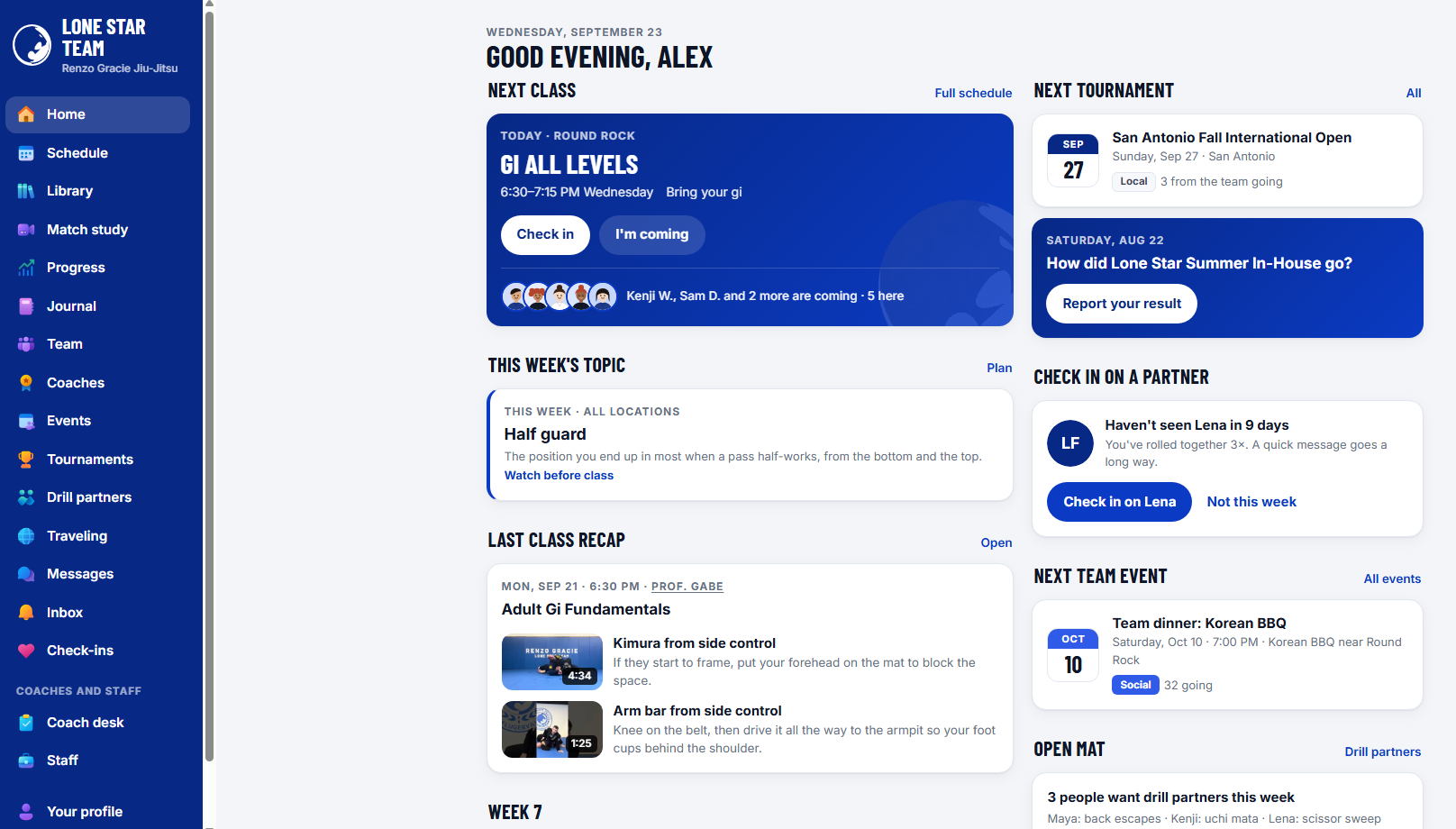
I’ll give you an example from one of my hobbies, Brazilian Jiu Jitsu. I asked Claude to research the student retention problem in BJJ and try to come up with an app to fix it. It’s no secret that most people who try out BJJ will quit, often within the first 6 months. It’s not a ton of fun to get smashed by everyone every day. Since everyone that started training at the same time as you also gets better, you don’t really see progress until a brand new person signs up 6 months after you and you smash them instead. Then it starts to click, but getting to that part is hard.
Claude said the two things that can help with retention are: becoming part of the community by making friends and having a structure to their training. So I had Claude research and plan how to do just that. It built the website in a weekend. I’ll leave you with a screenshot of the mock-up below. Normally this is where I would like to an open source repository… but why bother, you can have Claude build you a custom one for whatever hobby you want to help solve whatever problem you encounter by following the steps above.